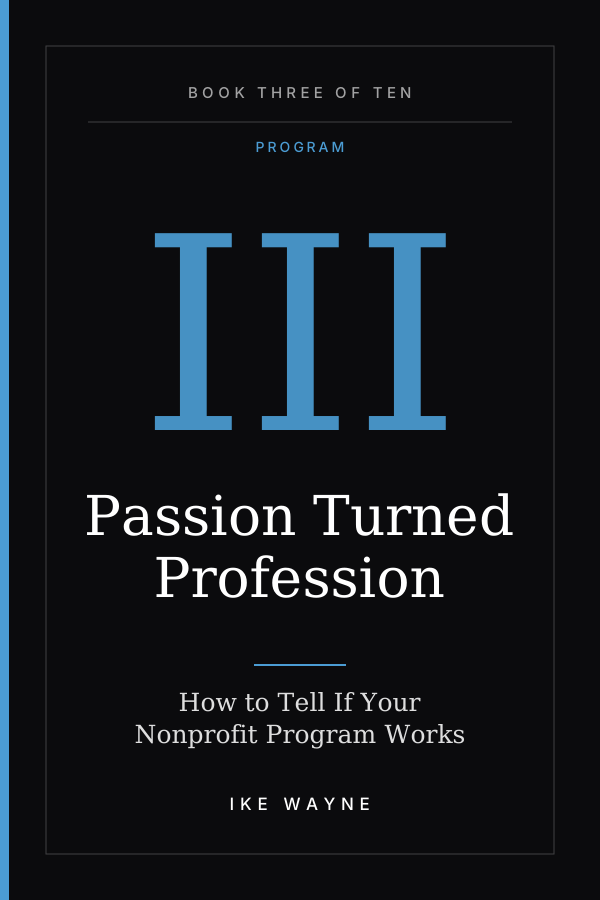
Passion Turned Profession · Book III · Mission and program
How to Tell If Your Nonprofit Program Works
A program is a hypothesis. You are claiming that if you do a specific thing, a specific change follows — and a claim can be wrong.
25 chapters · 238 pages
What it is
Most programs are never examined, and the reason is not negligence. Examination feels like doubt, and doubt feels disloyal toward the people you are trying to serve. So the design remains in one person’s judgment, eligibility is decided by whoever answers the telephone, and the dose declines until what is delivered is a gesture.
The book is practical rather than academic. Theory of change without the jargon, on one page. Dosage, and the threshold below which a program is not being delivered. Fidelity, and which components are load-bearing. The pilot, which is a question with an end date rather than a smaller version of the program. Intake, safeguarding, participant voice, and maintaining quality when nobody is observing.
Then measurement you can conduct with volunteers and a spreadsheet, and the harder discipline of reporting what you found without overstating it.
An unexamined program is not a humble program. It is an experiment being run on people without anyone admitting it is an experiment. Book III · How to Tell If Your Nonprofit Program Works
What this book assumes
That a program is running, or about to begin. Formation is Book One.
Every chapter
25 chapters, and what each one does.
Every chapter, with the sentence it opens on.
- 01
A Program Is a Hypothesis
You are claiming that if you do a specific thing, a specific change follows. That is a claim, and it can be wrong.
- 02
Theory of Change Without the Jargon
One page, five columns, plain words. If it needs a key, it is not doing its job.
- 03
Who You Serve, and Who You Turn Away
Every program has an eligibility boundary. Most have never written it down, which means it is being drawn by whoever answers the phone.
- 04
Dosage
How much, how often, for how long — and the threshold below which you are delivering a gesture.
- 05
Fidelity, and the Right Amount of Rigidity
Some parts of your program are load-bearing. Most are not. Knowing which is which is the whole skill.
- 06
Borrow Before You Invent
Somebody has probably already tested this, and they will give you the answer for free.
- 07
The Pilot
A pilot is not a small version of your program. It is a question with an end date.
- 08
Intake and the First Contact
The first ten minutes teach a person what kind of organization you are, and they are usually designed by nobody.
- 09
Safeguarding and Duty of Care
The chapter you hope never becomes relevant, written on the assumption that it will.
- 10
The Session Itself
The unit of your program is not the year. It is the hour, repeated.
- 11
Staffing a Program
The question is not how many people. It is which parts of the work require which kind of person.
- 12
Training and Supervision
Training is what you say once. Supervision is what makes it true a year later.
- 13
Records, Notes, and Data a Volunteer Can Use
If it takes more than two minutes, it will not happen. If it is not written down, it did not happen.
- 14
Participant Voice
The people receiving your program know things about it that you cannot find out any other way.
- 15
Quality When Nobody Is Watching
Quality is not a standard you meet. It is a set of small habits that survive a bad week.
- 16
Outputs, Outcomes, and the Difference That Matters
You served two hundred people. That is not a result. It is a receipt.
- 17
Measuring Without a Researcher
You will not run a trial. You can still find out.
- 18
Honest Claims
The difference between what happened and what you caused is where most nonprofit communication quietly breaks.
- 19
What the Data Will Not Tell You
Measure what you can. Then be honest that the most important thing may not be on the list.
- 20
Reporting
Three audiences, three documents, one set of facts.
- 21
Improving
One change a year, chosen deliberately, beats twenty changes a year chosen by whoever spoke last.
- 22
Scaling Without Breaking It
Growth is the most common way a working program stops working.
- 23
Referral Networks
You are one service in somebody's life. Behaving as though you are the only one is the most common design error in the sector.
- 24
When a Program Should End
The hardest sentence in this book: it worked, and it is time to stop.
- 25
The First Cohort
A plan for designing, launching, and learning from your first twelve people.
Two more lines from inside
From the manuscript.
You served two hundred people. That is not a result. It is a receipt.
Book III · How to Tell If Your Nonprofit Program Works
It is usually better to serve fewer people at full dose than more people at half dose.
Book III · How to Tell If Your Nonprofit Program Works
-
What this book assumes
That a program is running, or about to begin. Formation is Book One.
Each subject is treated once, in the book that owns it. Where an answer belongs elsewhere, you are given the chapter reference.
Get the complete set
All ten books, plus the toolkit.
Passion Turned Profession is available as a complete set for $149: all ten books in PDF and EPUB, plus the forty documents printed in Book X as editable Word files. The books are not sold separately.